ONCUPINAR, TURKEY— More than 25,000 Syrian civilians have become the unwitting victims of a standoff between Turkey and Western relief agencies.
The Turkish government refuses to admit the refugees, the first in a
wave of civilians fleeing an offensive by the regime of Syrian President
Bashar al-Assad in the northern Aleppo countryside. Turkish officials
say their country has reached the limit on the number of Syrian refugees
it can admit.
In a bid to pressure the government of President Recep Tayyip
Erdogan, United Nations and Western relief agencies are refusing to
dispatch aid across the border to the refugees. “Some relief
organizations have asked us to assist them to transport supplies to help
these newly-displaced Syrians, but we have declined,” a U.N. official
told VOA. “If we agree, it is likely the Turks will continue to refuse
to admit them.”
An official with the International Organization for Migration said,
“Our position is clear: they are war refugees and they should be allowed
into Turkey.” Both officials asked not to be named in this article.
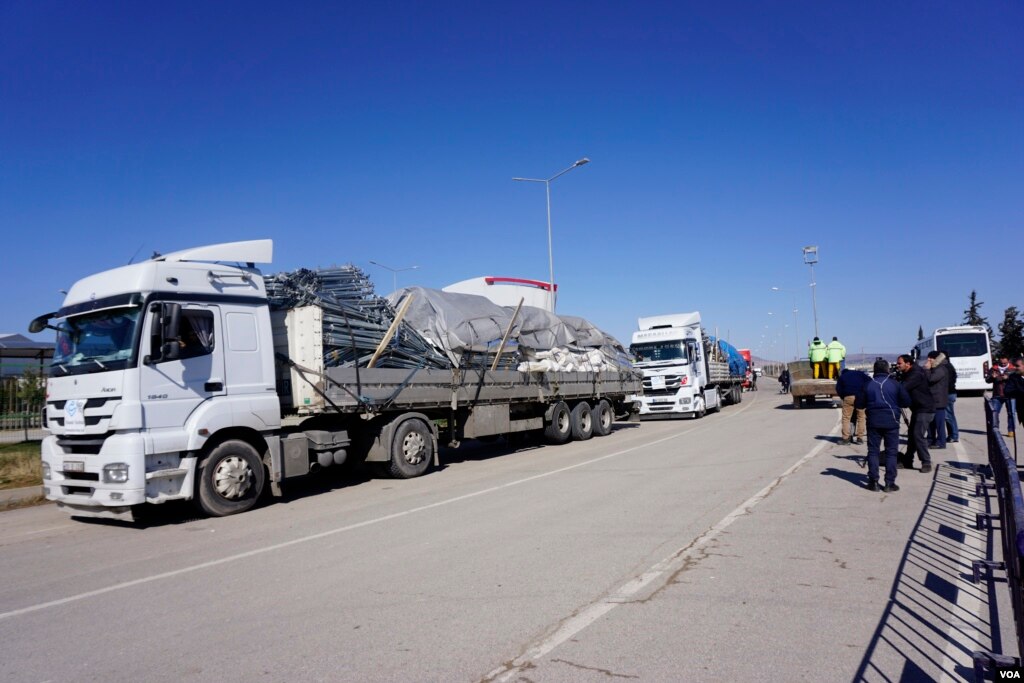
At Turkey’s Oncupinar border crossing, only a few relief trucks
crossed Monday into Syria, not one with U.N. or Western charities and
relief agencies logos. The trucks that crossed were from the
Independent Doctors Association, a private Syrian charity, the Turkish
Red Crescent and IHH Humanitarian Relief Foundation, a Turkish NGO.
Most of the half-dozen trucks carried tents and camp construction
material, suggesting that Turkey is planning for the refugees to stay on
the other side of the border for the time being and is not near to
succumbing to Western pressure.
Trucks
carry tents and construction material to be used for make-shift refugee
housing, in Oncupinar, Turkey, Feb. 8, 2016. The supplies are destined
for refugees on Syrian territory whom Ankara refuses entry into Turkey.
(Photo - J. Dettmer/VOA)
Desperation at border
Zakaria Ibrahim, who oversees the Syrian Red Crescent’s mission in
Azaz, the closest Syrian town to the border here, says there are
approximately 25,000 refugees on the Syrian side.
“There are 890 families - just over 6,000 people - right by the
border crossing. Another 530 families - nearly 3,000 people - are in
Azaz. And about another 9,000 are scattered along the border.” He said
some of the displaced civilians, though, had gone further afield and
his mission is not able to estimate their number.
“The only supply deliveries are coming from IDA, our colleagues in the Turkish Red Crescent and IHH,” he confirmed.”
He said the refugees are desperate to cross into Turkey. “There are
about 20 collective tents separate from the semi-permanent camp that has
been there for months. The tents measure from 70 square meters to 100
square meters; but, they are not big enough to shelter everyone and some
of the tents are for women and children only.”
He added, “There are only five latrines for these people and they are
being used just by the women. The men have to relieve themselves in
the fields.
“The longer the Assad offensive continues, more villages and towns
are impacted. These people are just the first in a wave that will get
bigger.” The Syrian Red Crescent estimates that 25,000 civilians are
now close to the border near Oncupinar, some sheltering in nearby
villages.
Turkish officials put the number at more than 35,000 Syrians.
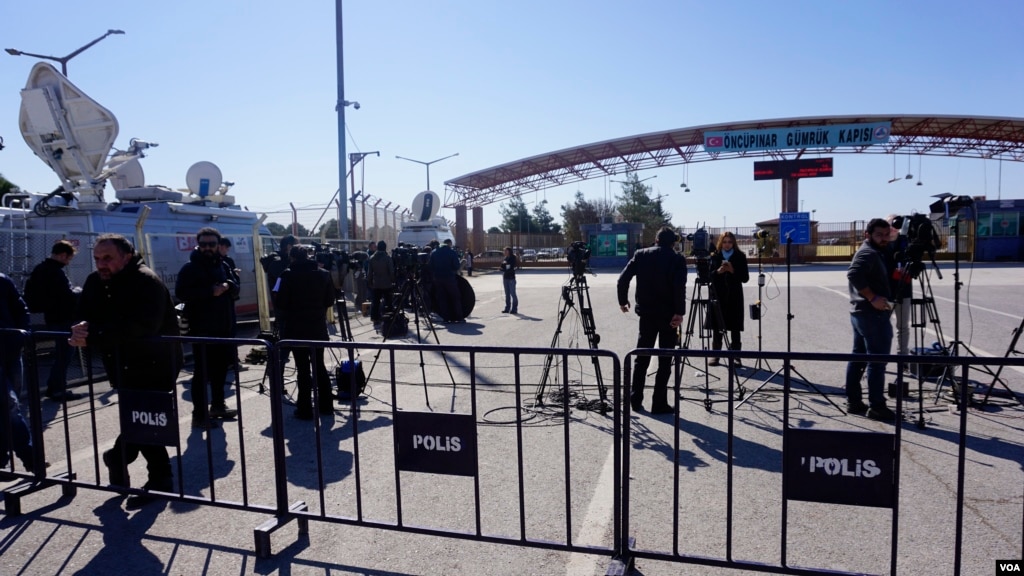
Members
of the press are seen at the Oncupinar border crossing, Turkey, Feb. 8,
2016. Ankara is refusing to allow dozens of Western journalists at
Oncupinar eager to cover the refugee story to cross the border into
Syria. (Photo - J. Dettmer/VOA)
‘Nowhere else to go’
Turkish Deputy Prime Minister Numan Kurtulmus told CNN-Turk
television Sunday his country has taken in three million refugees from
neighboring countries, most of them Syrians.
In an enigmatic remark, he also said, "In the end, these people have
nowhere else to go. Either they will die beneath the bombings and
Turkey will... watch the massacre like the rest of the world or we will
open our borders.”
President Erdogan recently said, "If necessary, we have to and will let our brothers in.”
With more tents being sent across the border, it remains unclear
when, or if, Ankara will open the border. The Syrian Red Crescent’s
Ibrahim says the Turks are planning to ship across another 250 smaller
tents for families.
European Union officials have urged Turkey to admit these new
refugees, but in an echo of arguments sometimes used by European
politicians seeking to curb refugees heading to Europe, a Turkish
official told VOA, “If we open the border, it will be like opening the
floodgates.”
While the Turkish government is refusing to let in Syrian refugees,
it is refusing to allow out dozens of Western journalists at Oncupinar
eager to cover the story.
Despite claiming the country has an “open border policy,” the Turkish
government has had most of the crossings along the border closed for
refugees for about a year. Syrians already registered in Turkey are
allowed back and forth across the border, especially during religious
holidays.
For the past week, even the traders’ corridor has been closed and the
normal crowds milling around by the Oncupinar border post have
disappeared - replaced by the press corps.